

Service Quality & Performance Model

Educational Providers
An extensive study has been carried out by Dr Nadith Kawshalya – Chief Commercial Officer of London School of Marketing, Dr Penny Hood – Founding Director of Hood International Consultants, to understand why students chose to study at privately funded higher educational institutions in the UK and their expectations. This study was carried out from January 2009 to October 2014, with over 12,700 students taking part in the research.
The aim of the research was to identify, evaluate and develop service quality measures/dimensions – from the students’ point of view – at independent Colleges in the UK. The primary objective of the study is to determine whether private higher education providers in the UK meet student expectations. In order to achieve the primary objective, the research identified two secondary objectives as: what are the areas of service quality that are most important to students, when choosing to study at a private college in the UK; and does their chosen private college meet student expectations in all these areas?
The research consists of three stages:
An extensive analysis of literature followed by discussions with industry experts to map recent developments within independent colleges in the UK,
An analysis of a student focus group discussions as well as an expert panel review, of the focus group findings, in order to develop the initial conceptual model and the development of the measurement instrument i.e., online questionnaire, and
The online questionnaire link was then promoted to qualifying participants internationally using the official website (www.service-quality.co.uk) as well as social media, such as Facebook, LinkedIn, and Twitter. In addition, links to the survey and the progress have been listed at several discussion groups as well as included in online press releases.
The online questionnaire was made available from 1st June to 30th November 2013, to ensure sufficient time was given to promote the survey and attract a good number of responses.
12,775 completed questionnaires were gathered during the six months period. The sample data was analysed for the normality of distribution followed by assessment of validity and reliability, using parametric statistical analysis tools.
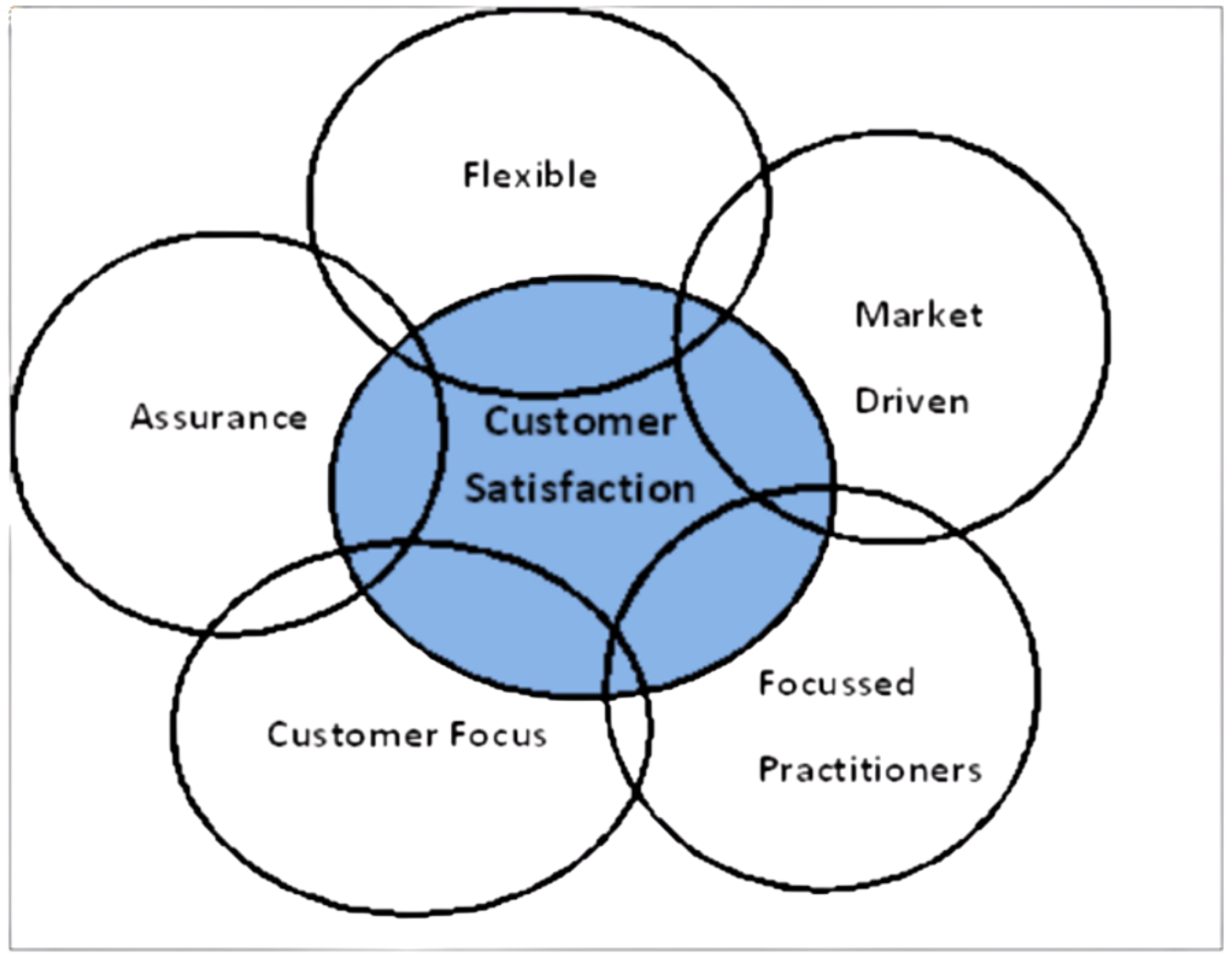
Finally, the research concluded that students chose to study at independent colleges as they offered five service quality dimensions as: flexible, market driven, assurance, customer focus and focus practitioners. The participants also agreed that their chosen independent college either met or exceeded their expectations. The research findings were inconclusive in terms of the order of importance of these service quality dimensions.
The service quality and performance model for independent colleges in the UK requires these three components: service quality dimensions, measures, and implementation points, to continuously refine and develop. Following such a model, the organisation will continuously identify and refine the service quality dimensions and measures to meet changing student expectations on a continuous basis, whilst sustaining positive service gaps, thriving to remove negative service gaps and by converting neutral areas to positive service gaps.
This webpage is designed to further enhance the findings of this study by engaging in a wider and ongoing discussion in this area of research. You can find further details of this study, followed by several additional articles that give further details of the findings and data analysis.
Independent colleges
The Higher Education Statistic Agency’s (HESA) report on private and for-profit providers of Higher Education in the UK 2009/10, identified over 56,000 students studying in privately owned higher educational institutions in the UK, and this number grew to over 160,000 in 2011/12 (HESA, 2011). For example, private providers of education play a vital role in the market and offer qualifications in a wide variety of sectors and study modes (BAC, 2011). HESA’s report further claims that qualifications ranging from Level 3 Foundation Diplomas to Level 7 Postgraduate qualifications are offered via a variety of study modes, including full time face to face study, part time evening, part time weekend, block release as well as online (HESA, 2011).
Of the 160,000 Higher Educational learners studying at private institutions during 2011/12, approximately 60% were studying full time, with 21% part time and 18% via distance learning. This shows that students see private providers as a good alternative to state funded educational establishments, as they not only attract students who would like to follow qualifications on a part time basis, but also the majority of students studying on a full time basis. The BIS’s report further identified nearly 60% of the learners were domiciled within the UK and EU, meaning only 40% of students are from non-EU countries (BIS, 2013).
However, it is worth noting that over 60% of students that are studying qualifications in business and administrative qualifications opted to study as either part time or distance learning, whereas nearly 90% of students that have chosen to study subject areas such as arts, medicine and law, chose to do so as full time students.
Interestingly, nearly 65% of private providers identified themselves as ‘specialist’ providers, meaning they simply focus on one subject area, with over 30% of the providers specialising in the areas of business, management, accountancy or Information Technology, and less than 5% of providers focussing in areas such as science, technology, engineering or aviation. The average number of qualifications offered by private providers was limited to four qualifications, meaning the focus is in developing a robust commercial model by offering few qualifications to attract a relatively large number of students, in order to make the operations worthwhile (BIS, 2013). Accordingly to Middlehurst and Fielden (2011), most private providers focus in the area of business, law, computing, hospitality and tourism during their start up and development stages, as is the case in the UK private education sector, and usually branch out into areas such as social sciences and healthcare at later stages of their development.
Key providers within the private colleges in the UK
This section aims to identify key providers in each area of the functional categorisation and how they operate in the UK. As described above, this categorisation is based on previous studies by Middlehurst and Fielden, (2011), feedback from expert interviews as well as the secondary research by the researcher. Accordingly, this website grouped private colleges into two broad categories as deliverers of academic content and providers of academic support to higher education.
Delivery of Academic Content
Delivery of academic content covers the majority of private providers, those organisations actively involved in delivery of the qualifications via their own lecturing staff members and using their own teaching facilities. Further, this research identified four sub-categories in this section: those offering a UK degree with their own degree awarding powers; those which offer their own non-UK awards; those which offer degrees of publicly-funded universities; and awards involving various public/private partnerships in content design and delivery.
Providers with degree awarding powers
Several private providers currently have taught degree awarding powers in the UK and therefore are officially classified as having the same status as publicly funded institutions for visa and funding purposes, such as Higher Education Institution (HEI) status by the UK Immigration Authority or Recognised Body (RB) status with the Department of Business Innovation and Skills.
Providers in this category as of 2013 include, but are not limited to, BPP University College Ltd, the College of Law, the University of Buckingham, Ashridge Business School and Regents University College. There are also several others in the process of obtaining such powers, such as Resource Development International as well as Kaplan.
Further, these providers offer taught degree qualifications in the UK, with many categorised as top end providers in their chosen subject specialisation. For example, Ashridge Business School is regarded as one of world’s leading business schools by the Financial Times Business School ranking (2012), and the College of Law, similar to BPP University College, is regarded as a leading law school in the UK.
Private providers offering their own non-UK awards
These private providers offer non-UK based qualifications to their students, with a majority of providers linked to American Universities and some with other European universities.
Some of the key providers in this category include American InterContinental University, Richmond American International University, Schiller University and Hult International Business School (formerly Huron University). These providers offer qualifications that are awarded by non-UK based universities, but with comparisons to UK qualifications, via UK NARIC, the National Agency are responsible for providing information, advice and expert opinion on qualifications worldwide
In addition, international specialist providers such as Laureate Group, who have recently launched their London based prestigious hotel management school; Glion, which offers Swiss undergraduate and masters qualifications in hotel management, catering and culinary arts can also be listed under this category.
In addition to the above, many non-UK providers make their degree qualifications available in the UK as distance learning qualifications. The partnership of the University of Phoenix is a good example for this model.
Private providers offering an award from a UK or foreign partner institution
This is the most commonly used model by private providers, as this model simply enables private providers to offer university degrees via franchise or validation agreements. These providers, regardless of whether they are private or public, are recognised as listed bodies by BIS. As per the BIS’s description, listed bodies are institutions, which do not have the power to award their own degrees, but may provide full courses which lead to a degree of a recognised body.
This area has further developed since 2013, where universities started to have an equity stake in private providers and called them ‘branch campuses’. As a branch campus, these private providers have similar rights to their parent public sector provider, but the number of qualifications offered have been streamlined to attract the fast growing student market.
There are several branch campuses that currently exist in the UK (as mentioned in table 4 above): London College of Accountancy working as branch campus of Anglia Ruskin University, West London College working as branch campus of Heriot-Watt University, QA Business School’s Partnerships with University of Ulster, City of London College and University of Salford and E-Thames Graduate School of University of Sunderland.
In addition, a further 198 institutions work as franchise or validation degree providers (BIS 2013) in partnership with recognised UK bodies. Some examples include London School of Marketing, Kaplan and Amity College working with Anglia Ruskin University, British Institute of Technology working with Coventry University, London School of Business and Finance’s arrangement with University College of Lancashire and University of Lincoln as well as Greenwich School of Management’s agreement with University of Plymouth.
In addition, many private providers work in partnership with UK and non-UK based awarding organisations to offer vocational qualifications, which are accredited by the Qualifications and Credits Framework (QCF). Awarding bodies that are widely associated with private providers include Pearson/Edexcel, Association of Business Executives, Chartered Institute of Marketing, Association of Chartered Certified Accountants and Chartered Management Institute. Many of these awarding bodies have their own progression arrangements with UK and non-UK based universities, and graduates can apply for degree programmes with advanced standing. Some examples of private providers working in partnership with these awarding bodies include Oxford College of Marketing, BPP Professional, Cambridge College of Marketing and St Patricks.
Public/private partnerships in content design and delivery
There are instances where private colleges or institutions have their programmes validated by a public sector provider. Even though Middlehurst and Fielden, (2011) and Crossick (2010) argued that validated degree qualifications are better suited at the category above, this research believes that the validated degrees, where a public sector university awards a qualification that is tailor made and designed for a private provider, is more suitable under this category, as in many instances the same qualification is not available at the validating university’s main campus.
Examples of this approach include the validated qualifications of London School of Commerce by the University of Wales Institute of Cardiff, Kensington School of Business’s validated qualifications by Cardiff Metropolitan University and Magna-Charta College’s validated degrees by University of Wales.
Further examples include, IFS Business School’s joint award with University of Surrey and European Business Schools qualifications with the Open University.
In addition to this, several private providers act as content providers for public institutions and support distance learning provision. Example include, Home Learning College providing content to several awarding bodies, Resource Development International working as distance learning support providers to several UK universities, London School of Marketing delivering Anglia Ruskin University degree qualifications and Pearson Education publishing supporting degree qualification delivery of Heriot-Watt University.
Providers Offering Academic Support to Higher Education Institutions
This area is comparable and similar to pathway providers (Middlehurst and Fielden, 2011), as these institutions offer qualifications leading to entry or advanced entry to a degree qualification at a University. Therefore these providers do not compete directly with universities, but simply act as feeder centres by having clear progression arrangements with universities, in many cases by closely aligning their qualifications with the entry requirements of university degree qualifications.
There are two distinct categories of providers in this area; providers of integrated foundation qualifications and other support centres.
Integrated foundation providers are private institutions which have direct and formal arrangements with universities to accept their graduates, usually for the first year entry to undergraduate degree qualifications or entry to master’s degree qualifications. Three key institutions of this nature operate in the UK; the Navitas Group working in close partnership with nine UK Universities, including Anglia Ruskin University, University of Hertfordshire and University of Portsmouth. INTO group, working in partnership with City University, University of East Anglia, University of Exeter, Glasgow Caledonian University and University of Manchester. Finally the Study Group is also a well-established provider and works in partnership with University of Brighton, Heriot Watt University, University of Huddersfield, Keele University, Kingston University and University of Lancaster. In many instances, these providers operate within their partner University’s premises to provide a closer integration with progression for their students.
In addition to the three main providers mentioned above several other providers have informal links with universities, to accept students for their degree qualifications. These providers, classified as other support centres, include Cambridge Education Group, Kaplan International College and British Study Centres. In addition, according to the Independent Schools Inspectorate, several hundred English language and further educational colleges also act as feeder centres for public sector universities in the UK. The leading institutions in this category include, London Study Centres, St Giles School of English, David Game School of English, International House and Oxford House College.
The classification above recognises and identifies private colleges by their function and the role played in terms of their arrangements with awarding organisations. However, according to the feedback received from the experts, the market is dynamic and prone to change, mainly as a result of wider governmental policy changes. Therefore, the next section of this chapter will focus on potential future developments and likely changes that private colleges can expect to have in the next few years.
Key references
Crossick, G. (2010) The growth of private and for-profit higher education providers in the UK, Universities UK (available at https://www.gov.uk, and accessed on 20 November 2013)
Department for Business, Innovation and Skills – BIS (2012) Applying student number controls to alternative providers with designated courses (Available at www.gov.co.uk, accessed on 30 November 2012)
HESA (2011), Press release 159: Survey of private and for-profit providers of Higher Education in the UK 2009/10, HESA (Available at www.hesa.ac.uk/pp, accessed on 3 May 2011)
http://www.hepi.ac.uk/455-1969/Private-Providers-in-UK-Higher-Education–Some-Policy-Options.html (Accessed on 8 August 2011, at 17.15PM)
http://www.hesa.ac.uk/index.php/content/view/2090/161 (Accessed on 11th December 2013)
http://www.qaa.ac.uk/partners/students/reviews/pages/REO.aspx (Accessed, 10 August 2013)
http://www.study-uk.org/ (Accessed on 15 June, 2012)
Middlehurst, R., and Fielden, J. (2011) Private Providers in UK Higher Education: some Policy Options, Higher Education Policy Institute (Available at www.hepi.ac.uk, accessed on 16 January 2014)
Profiles
Dr Nadith Kawshalya – Principle researcher
Nadith boasts a wealth of experience as a seasoned business development professional. Over the span of 25 years, he has occupied pivotal roles in top and middle management positions within both state and independent educational institutions as well as consulting firms across the UK.
During his tenure as the Chief Commercial Officer at the London School of Marketing, Nadith demonstrated his prowess by forging strategic alliances with international universities, awarding bodies, and industry partners. His visionary approach led to an exponential surge in the business turnover, skyrocketing it from under £1 million to an impressive figure exceeding £15 million.
His expertise extends to managing significant international contracts with esteemed global organizations. Notably, Nadith has collaborated with renowned entities such as The InterContinental Hotels Group, Virgin Atlantic, Gordon Ramsay Holdings, Anglia Ruskin University, The University of the Arts - Central St Martins, Harrods, and London Corporate Training.
A co-founder of the Chestnut Education Group, Nadith directs his focus toward corporate and executive training programs, digital consultancy, and business outsourcing. In his current capacity as the Chief Executive Officer of the Group, he remains a driving force behind its strategic growth. Under his guidance, Chestnut Education has emerged as a prominent student recruiter in the UK, having successfully enrolled over 15,000 students since its inception. The group has forged strategic partnerships with prestigious institutions like Anglia Ruskin University, University of Central Lancashire, University of Leicester, University of Derby, and Arden University.
Nadith's academic achievements are as impressive as his professional career. He holds a BA (Hons) in Business Administration, a Master’s degree in Accounting & Finance Management, and an MBA. He is a qualified Chartered Marketer and holds a Doctorate in Service Quality Management. Adding to his academic laurels, Nadith recently completed a Master's degree in entrepreneurship at the esteemed Judge Business School, University of Cambridge.
His affiliations and memberships are testament to his commitment to continuous learning and professional development. Nadith is a Fellow of the Chartered Institute of Marketing (FCIM), a Member of the University of Oxford's Business Alumni Network (OBA), and an Alumnus of Homerton College (University of Cambridge), Judge Business School (University of Cambridge), as well as the Harvard Business School's Executive Alumni Association.
Publications
This research aims to understand and determine the factors that are important to students, such as in service quality dimensions; in choosing to study at privately funded colleges in the UK and to develop an empirical model from the student’s point of view; to identify and understand what students ‘expect’ from their private educational college; and what they actually ‘experience’. Therefore, this research can be defined as an exploration in to service quality dimensions and student satisfaction at Independent Educational Colleges in the UK
In this page you can download and view various publications made as a result of this research. We have invited other academics and professional writers to contribute towards these publications as a part of creating a wider point of view of the study and its findings.
Scope of the research, limitations and challenges
Even though higher education is generally defined as post 18 year education (British Council, 2012), the initial study revealed that many 17 year old students are currently studying or have previously studied at Private Colleges. These students are mainly studying for foundation level qualifications or professional qualifications at the Level 2 or 3 standards within the Qualifications and Credit Framework. Some examples of these qualifications include Travel and Tourism certificate qualifications offered by awarding bodies such as City and Guilds; Business Certificate qualifications offered by Pearson Education as well as PreUniversity qualifications offered by providers such as Navitas and INTO. Therefore, students that are aged 17 years and above have been invited to participate in this study, as this group is considered as a major entry level student segment and if a private college meets or exceeds their expectations, it is likely that this group of students remain with the private provider to progress on to degree level qualifications (ibid). This decision is in line with definitions by the Higher Education Statistics Agency (HESA), which defined Higher Education as courses where the level of instruction is above Advance Level. Our preliminary study indeed showed that many qualifications offered at privately funded colleges accept students at the age of 17 years for Professional Certificate awards as well as Foundation qualifications, where private providers such as West London College, Williams College, E-Thames Graduate School and many others offer qualifications for students at the age of 17 years. This claim is further supported by the Home Office UK, where the qualifying age for an adult student, known as Tier 4 General, has been set for students of 16 years and above (Study UK, 2012).
This research focused on students studying at a private college during the last four years (from June 2009). The reason for this limitation was based on two considerations. Firstly, Private Colleges have undergone major changes in regulations and quality assurances since the beginning on 2009, and therefore this study focused around the modern image and the state of play with the private providers in the UK; refer to chapter two for developments within the private colleges.
Secondly, students that may have studied at a private provider prior to this period may be unable to recall their experiences fully and contribute accurately to the study. Further, these studies focused on students of the age of 17 years and above, at the time of their study at a private college to ensure only adult students are involved in the research. This decision was taken to overcome ethical and regulatory requirements involved with minors, as well as being safe to assume that adult students are more likely to have established their expectations from the private college and therefore in a better position to contribute to the study.
One of the key challenges this study is likely to face is the wide geographical spread of students. Many international students who have studied at a private college during the last four years may have returned to their home countries. Further, it is also important to gather data from students that are currently studying at a private college, especially at various stages of their qualification – at the beginning, half way and near the completion- to have a good understanding of how their expectations of service quality dimensions may have changed. Further, due to ongoing changes introduced by the Immigration Authorities in the UK as well as their accrediting bodies, many private providers may hesitate to encourage their students to participate in a study of this nature, especially if wider quality gaps exist and such disclosures may adversely affect their approvals with their accrediting bodies.
Steps Involved In The Study
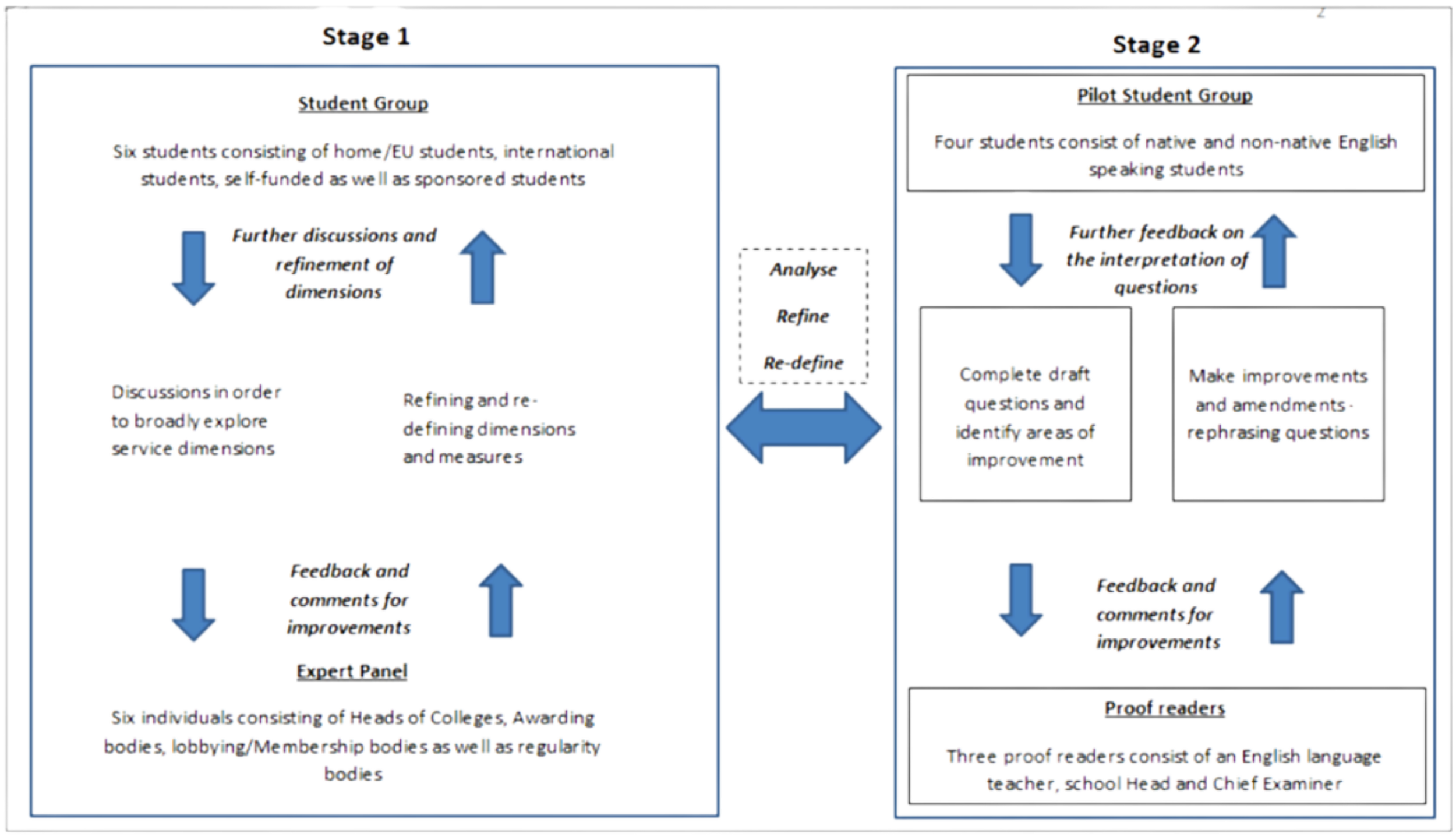
In this study, the research methodology consists of three stages, as described in the table below:
Interlinked dimensions and customer satisfaction
After looking at a variety of ways of designing these interlinked service quality dimensions, the researcher, expert panel and the focus group concluded an interlinked diagram showing these five dimensions to reflect the feedback from students more effectively. The diagram below shows how these five service quality dimensions link up to create the overall student satisfaction, as the performance of one dimension will naturally affect the others.
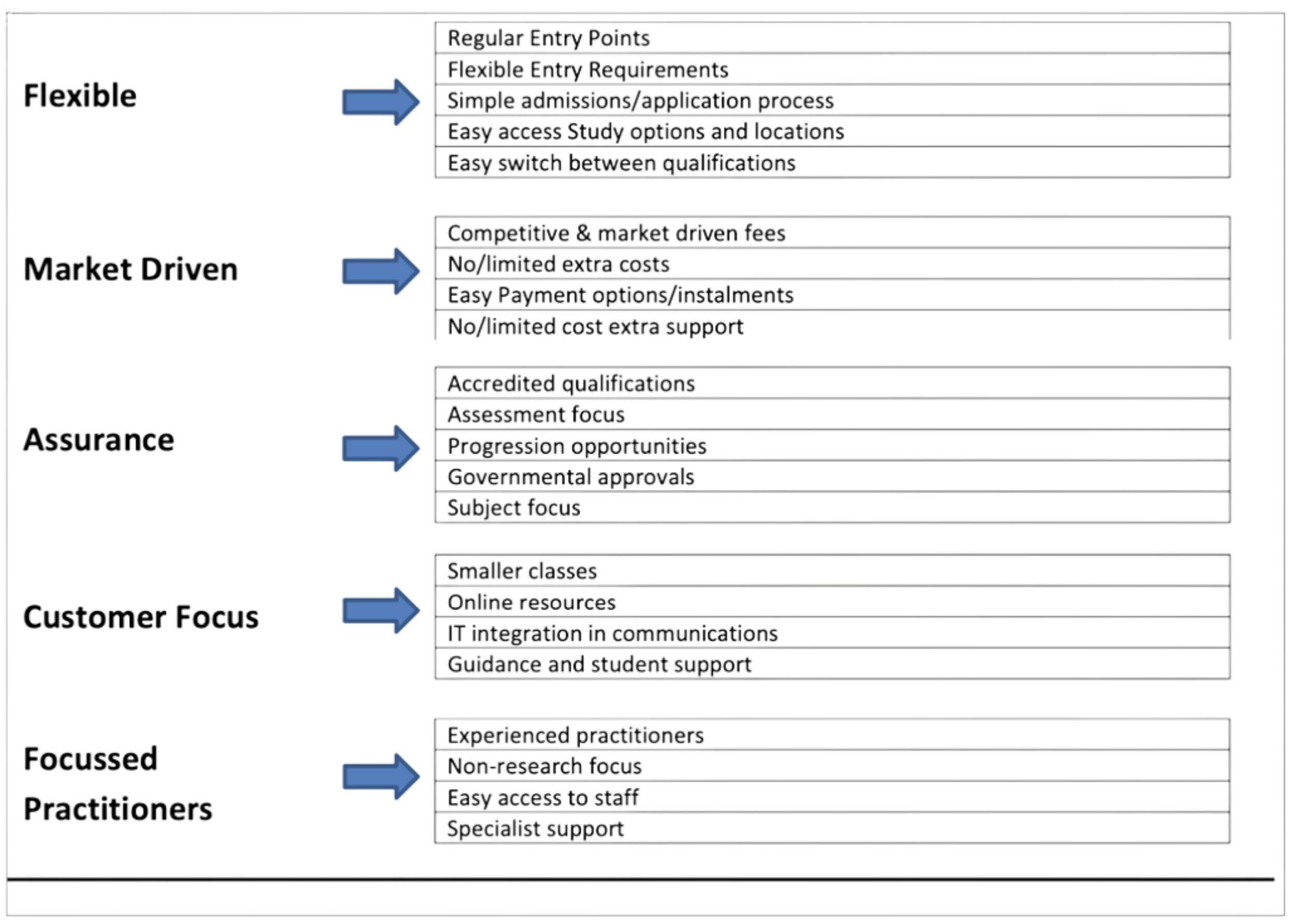
As seen from the diagram above, the total number of statements and their respective allocation are as follows: flexible and assurance, five questions each, market driven, customer focus and focus practitioners with four questions each.
service quality implementation points
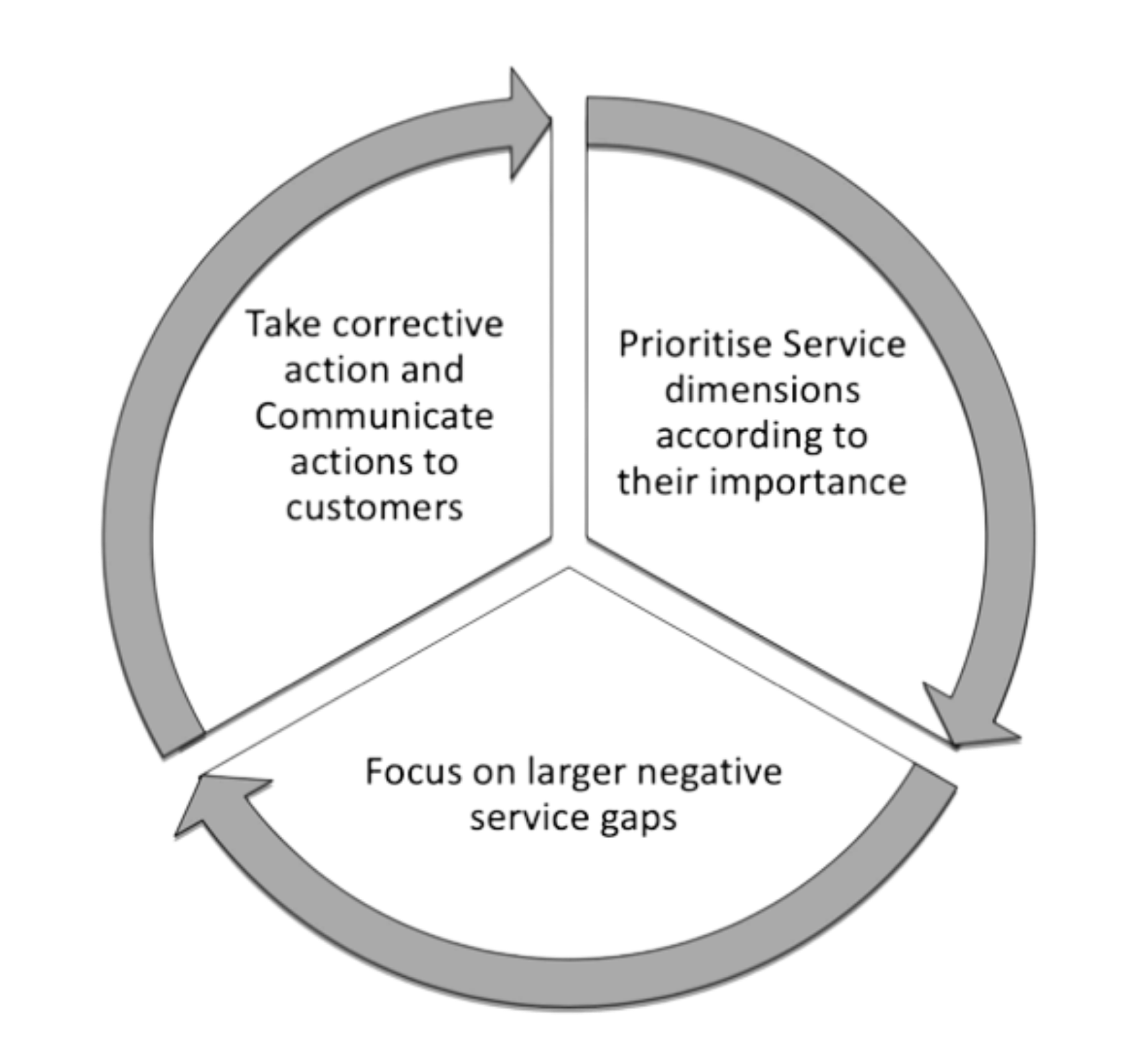
Service quality is a continuous process and evolves with the changing customer needs and expectations. Therefore service quality dimensions, measures as well as implementation points require regular evaluation and assessment. For example, the measures for each dimension are likely to change depending on the qualification delivery, student mix as well as during length of their qualification, whereas the importance of service quality dimensions can deviate depending on the student needs and qualification requirements
Service quality and performance model for independent colleges in the UK

As seen from the diagram above, the service quality model is a dynamic tool which will enable private colleges in the UK to continuously monitor and assess the level of student satisfaction. The dimensions itself are likely to change, therefore definitions associated with dimensions require continuous assessment and refinement. The same is true for the 22 measures associated with the five dimensions. These require refinement and adjustments on the basis of the changing customer needs and expectations.
You can access the full report at https://arro.anglia.ac.uk/id/eprint/337206/1/final%20thesis%20-%20Kumarapperuma.pdf